Saturday, 27 October 2012

1.5 Colour Study (1)

I have always had trouble mixing paint colour which is probably way I try to avoid painting and often draw with pencils or pastels.  For this exercise I chose three photographs, the bottom strip is of pebbles, the middle rock pool and the top a row of buildings in a side street.  I looked through a narrow strip window at a portion of the photograph and tried to reproduce the colours using acrylic paints.  This is not my most successful piece in the actual reproduction of the colours but I do like the strip effect. 


#1.5.1
I decided to use the colours in the top strip to extend this exercise.  I mixed the yellow and blue in increasing proportions and look at the colour range, before cutting the mixes into squares for the next exercises.  Again my mixing of the paints was not as successful as I had hoped and I therefore decided to look into colour theories a bit more before moving on. 

#1.5.2
I first mixed my own colour wheel using three colours:
  • Lemon yellow
  • Cadmium red
  • Cerulean blue
I was quite pleased with the result, particularly as the full twelve colours were produced from these three primaries.  The blue-green range and blue-red range would have benefited from a better mix of colours to achieve a better transition in the hues.  I added some brief labels to the wheel so that I can refer back easily to colour theory as I progress through the diploma.  

#1.5.3
I mixed white and black to the primaries to produce the various tints/shades; I then mixed the complimentary colours to see what colours were produced.    

#1.5.4                                             #1.5.5
I also decided to read a couple of books on colour theory - Colour:  How to use Colour in Art and Design by Edith Anderson Feisner; Interaction of Colour by Josef Albers; and Colour:  A Workshop for Artists and Designers by David Hornung.  The last book contains a series of assignments to help you understand colour and I might continue to undertake the assignments as I work through the diploma.  

I decided to go back to the projects but use colour paper for some of the exercises; this was suggest in one of the books.  The next images shows five pages of small colour squares against a different larger coloured square to look at colour perception and the effect of one colour on another when placed next to it.   

#1.5.6
Each set of six small squares is A3 size, with the lower set of nine squares also A3 size.  

Looking at the squares close-up, I could not see much difference in colours.  I had to move the sheet quite a distance to perceive any changes.  I also started to think was I was seeing a difference because it was actually there or because I thought I ought to see a difference?

Looking at the squares with the small blue centre, the blue on yellow hues (1, 4 & 5) look darker in tone than the other squares, with blue on green a mid-tone (6) and blue on red (3) and violet (2) the lightest tones.  With the blue on red (3), the red seems to recede the most.  i would have expected with red being a warmer colour it would move forwards.

With the red inner square, the red appears darker in tone on the orange (7) and yellow (8); and lightest in tone on the lemon yellow (100.  The red on green seems most saturated (11). 

With the orange centred square, darker tones are produced on violet (14), yellow (15), and green (18).  The orange on red (17) and orange on lemon yellow (16) seem more saturated with the one on red (17) receding and the one on the yellow coming forwards.  

With the lemon yellow inner squares, darker tones are on the orange and green (19 & 21) and lighter, but more saturated, on the violet and blue (22 & 23).

The small grey squares illustrate the principle of 'after image' in colours.  After looking hard for some time I could see some red in the grey on green and violet in the grey on lemon yellow.

Friday, 26 October 2012

1.4 Shapes

When looking at my images of the coast and seaside towns the initial shape which caught my eye was domes.  Whilst this may seem strange, I think this comes both from the era when seaside began growing in the late Victorian period, when all things exotic were popular, and from the area I visited which is close to Brighton and the India-inspired Royal Pavilion.  Domes seemed to be everywhere, on roof-tops, as lamp-posts, on the pier, etc.  

#1.4.1

I pull together some drawings of domes to look at the various shapes.

#1.4.2

I also had some pictures of the Easter Cathedral in Russia and used one of these domes and associated shapes to produce a lino cut and tried printing some images onto paper.

#1.4.3

However, this shape did not seem to meet the brief of having enough inverted areas to develop the image.  I therefore looked back through my pictures and began to draw from a photograph the breaking wave shape.  I simplified the shapes to make a line drawing so that I could concentrate only on the shape of the wave.

#1.4.4

I made a tracing of the drawing and a smaller card template of the shape.  I then started some of the exercises to look at the effects on A5 paper and this is a college of some of the images.    

#1.4.5

I then produced a lino cut printing block of the image and began printing on both white and coloured A4 paper backgrounds.  I also cut up some of the images and re-arranged then to produce a new pattern.  the pencil drawings are my original images for the shape.   

#1.4.6

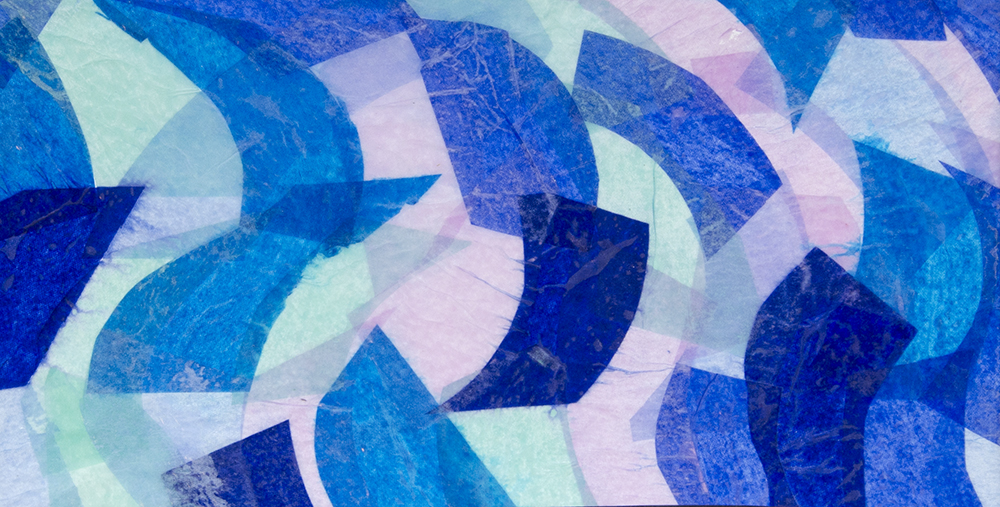
I particularly liked the effect of the gradually fading waves as the block is used without re-inking. I then used the curved wave shape and produced some shapes in tissue paper and glue them to cellophane, overlapping them to get different tones, as in my rock pool images earlier.  

#1.4.7

This over-lapping of transparent layers is something which quite interests me so could become part of my final project.

I need to think through how it will work when my overall design for my final project is better formed in my mind.  I have an idea of background layers of different images and shapes, with some form of ethereal images, based on my personal experience as a child at the coast.  I am also thinking at this stage of a narrative in my final image (as it is a wall panel), being alone as a child, how as we get old we become alone and, following a visit to Hastings where I saw many young people sitting alone, interfacing with their technology (iphones, ipads, etc.), rather than enjoying the beach and being part of the community.  All this is at a very early stage as I work through the research project. 

I produce another layered image using more geometric shapes, just because I enjoy the effect it produces - different tones which produce new shapes within shapes.   

#1.4.8


Sunday, 2 September 2012

1:3 Texture

My first thoughts when thinking of the textures I could re-create from the coast were of the beach.  I had completed a couple of sketches of the outlines of the pebbles and a watercolour on my first visit to Deal.  This had quite an isolated stretch of beach near the Sandwich Golf Club so I felt quite comfortable sketching with no one around. 


I then tried creating the beach using tracing paper cut into long strips with undulating edges and then curling them with the blade edge of scissors.  Whilst the size differences were apparent in the finished piece the undulating edges were lost so this piece was not very successful.


I then tried cutting out pebble shapes and to give them form, making a slit to the centre of the shape and forming them into domes.  Once stuck to card this give an effect of the
bi-valve shells often found on beaches.  I liked the pattens made by the light and shade in this image.      


I wanted the effect of the pebbles so tried forming tissue paper into 'pebble' balls and then sticking them to card.  This did not work as they quickly started to unfold so I wrapped thread around each pebble shape and then dabbed them with glue so they held their form.  This worked quite well although doubt began to form in my mind on how I would take any designs forwards.   


I then turned my attention to the sea and formed tissue paper into waves by spreading glue onto card and then gathering the paper into wave-forms.  This worked quite well.   


I also tried this using plastic bags which gave a better, more translucent water effect.


Finally, I produce a stylised string collage of the waves breaking on the beach and this is the image I liked the best. 


I then got into a creative block with textures.  I decided I did not like the images I was producing and for a few weeks just keep going round and round in circles without any clear way forwards.  As I looked at the pictures I could not get that creative spark I needed, they all just looked like organic shapeless images.  I even contemplated changing my personal research theme and got seriously stuck.  In the end I sat down to think about what I liked about textile art and it centred around line, colour and patterns.  Rather then abandoning my theme of the coast, I decided to visit Eastbourne, drawing and photographing the buildings.  I hoped this would give me the boost I needed.  Some of these images are in a previous post and many more will appear in later posts but overall the strategy did work.              
I have many childhood memories of sitting on the pier, watching people go by whilst I read my book.  I am the youngest of a large family and whilst I have many older brothers and sisters, I actually grew up fairly alone as by the time I was born and starting to grow-up, they were either staying at home with their friends or leaving home to start their own new lives.  Much of my time at the seaside was therefore spent exploring places on my own, walking along the esplanade, going into the town and quietly reading in various places.  Whilst this might sound quite lonely, I actually enjoyed being on  my own and having time to myself.  It has made me comfortable with my own company and quite independent.  

At Eastbourne I drew the image below of one of the roof of a building on the pier; it was the pattern of the tiles which caught my attention.
   

At home I then re-created the tiles using card, creating the texture by pressing the individual shapes on the end of a bamboo skewer. 

Completing this texture unit has helped to focus on the aspects of my personal research theme which I wish to develop and I am looking forwards to the next chapter. 

Sunday, 26 August 2012

1:2 Some Sketchbook Images

Having chosen my personal theme, I wanted to get straight into making some sketches as this aspect of the course probably causes me the most anxiety.  Whilst I can draw, I have always hated sketching in public and have a problem drawing in a sketchbook.  Rather than let this become a barrier to starting the course I have decided not to worry about a bound sketchbook and instead take with me pages from various paper pads held by bulldog clips on a wooden drawing board.    
To start me off I completed some simple pencil drawings of shells I have at home.  The shells were picked up during a recent walk at Folkestone and I particularly liked the broken nature of the shells with the holes and rough edges. 


The next weekend I went down to St Margaret's Bay; the sun was out and it was low tide so the rock pools were exposed.  I sat on a bench by the seafront and made a sketch of the cliff edges.  The vegetation here comes right up to the cliff edge and small outbuildings sit on lawns.  At the base of the cliffs rock falls can be seen from the erosion of the cliff face by the sea. 


Over at the rock pools the wind and sun were making fascinating patterns on the surface of the pools.  The surface was flat near the sheltered part of the pool and then mini oval wave patterns were catching the light from the sun.  In the pool the colours were mainly different shades of green from the algae and seaweed but in this particular pool there was a line of vivid blue being reflected and patches of orange and yellow.  I made the pencil sketch below as I had not brought any coloured pencils with me.    


The colours and patterns made by the reflected light and waves played on my mind when I got home so I decided to develop my sketch and produce some coloured images.  For the first drawing I used pastels on a green ground.  Whilst this caught some of the colours and pattens, it did not show the translucent nature of the pools or give an impression of depth. 


I then tried using acrylic inks.  I liked this result better, as it is brighter and gives the impression of the water and reflected light.   


I decided to try to take forward my rock pool images by stylising the shapes more and emphasising the reflective depths of the pools.  I therefore tried cutting quite bold shapes out of coloured tissue paper and sticking it to cellophane to give a shimmering effect.  The photographs did not bring out the boldness of the colours as I tried to catch both the tissue paper and the cellophane.  A happy accident in this picture is the texture created by the drying glue on the tissue and the effect it gives of the wind blowing across the pool.   


I then created another picture, introduced more colour and struck down a thread which had been soaked in a PVA glue/water mix to bring out the water pattern from the original sketch. 


During my next visit to the coast to overcome a creative block, I decided to look at the buildings and pier.  I therefore visited Eastbourne, which has real childhood memories for me of days spent going onto the pier and walking up and down the esplanade.  As a child this was our special place to visit as it was a bit further from home and therefore involved a longer car journey.  We were lucky to have good weather on the day we visited and this is a pencil sketch of the camera obscura building. 


When I got home I went over the sketch with black ink, as I think it really brings out the architectural details of the railings etc. 


I then added some pencil shading to add form.


Until this visit to Eastbourne I had forgot how long and wide the esplanade was and how the buildings at the seaside front were quite grand whilst those on the side streets quite modest.  I had taken some photographs of the buildings and an idea began to form to produce a drawing of a street plan with the building laying horizontial and the perspective wrong.  My initial drawing and the details are below:


As I go through the next few weeks I will develop these into a drawing and post the result.

Sunday, 24 June 2012

Exhibition: Whitchuch Silk Mill & American Museum

I visited the Whitchurch Silk Mill today.  The mill is the last working silk weaving mill in the UK.  Whilst quite small, it does show the various stages of silk weaving from taking the dyed hanks of silk and winding onto bobbins; then preparing the warp of the fabric from the various colours; before finally weaving the fabric weft on a traditional loom.  The amazing range of vivid silk colours were on show together with examples of the various silk fabrics –
taffetas, twills, organzas, satins, etc.
An exhibition of work by Anna Nowicki was also on show when I visited.  Seven fairy costumes inspired by a MidSummer Nights' Dream were displayed and you could see all the various fabric treatments and surface embellishments.  This included recycled shirts, garden wire covered in stitches, rusted cotton and blue silk, torn t-shirts and hand-dyed cottons.  Downstairs was a small display of Muse wall hangings, which had an appliqued quilt-style surface.
I also visited the American Museum in Bath.  This museum houses a wide range of decorative and folk art including native beadwork and quilts.  You can get quite close to most of the exhibits and see the way most of the pieces are constructed.   I found the log cabin and Amish quilts particularly interesting.  At various points throughout the house the different periods of American home interiors are displayed including the furniture and textiles.  There are a large number of domestic pieces on display such as tablecloths, bed linen, bedspreads and samplers.  The mill and museum are well worth a visit.

Friday, 8 June 2012

1:1 Initial Thoughts

As Coast was going to be my personal research theme, I began by putting down in a spidergram all my initial thoughts and ideas in association with this theme. 


As well as recording some of the obvious ideas generated by my theme Coast, it also helped trigger new and link together different ideas.  As I work through this part of the course I will refer back to the spidergram to look at diiferent themes within the over subject of the coast and hopefully it will help me overcome any creative blocks.   

Wednesday, 6 June 2012

Exhibition: Tracey Emin

I went to the Tracey Emin exhibition 'She lay down deep beneath the sea' at the Turner Contemporary in Margate today.  This exhibition shows a large range of expressive and free drawings, mainly featuring the reclining female nude.  Most  of the drawings are in blue gouache, which somehow give the drawings a lighter touch and feel.  The truly amazing feature of the drawings are the way lines which trail off in space and do not complete the outline still define the form of the nude.  
The exhibition also has a number of translations of the drawings in embroidery.  Blue satin stitch of various widths on a calico background define the strength of the line in the original drawings.  In some of the embroideries four sheets of calico are joined with blue and red running stitch, giving the images a cross symbol which resemble a flag.  Also included in the exhibition are four tapestries including Rose Virgin, which was my favourite piece.  All four tapestries had a watercolour feel and the originals were painted using quite a muted palette.   
Erotic images by Turner and Rodin are also included in the exhibition and this made me realise how certain subjects in art continually revolve.  
I really enjoyed this exhibition - the seemly quick, sensual, expressive drawings and the realisation on how a direct translation of a drawing into another medium can add another dimension to the image.  The exhibition runs until 23 September and is well worth a visit, detail can be found on www.turnercontemporary.org